 SoundFonts (.sf2)
A 1990s format that never got replaced
SoundFonts aren't a relic kept alive out of nostalgia. Thirty years on, they're still how MIDI karaoke players, retro-game emulators and chiptune tools get a real instrument sound — because nothing has actually taken their place.
 Download the Titanic bank →
.sf2 format · Works with any MIDI software
Is this still worth knowing about?
Short answer: yes, for a specific but real audience. SoundFonts aren't mainstream the way MP3 or streaming are — but they're not a dead format being documented out of habit either. Three communities keep using them actively: MIDI karaoke players (the exact use case of this site), retro-game emulation (DOSBox and its forks render old PC game music through a SoundFont-driven synth), and the chiptune/chipmusic scene.
What's more telling is what hasn't replaced it. Modern VST plugins dominate music production, but the ones that handle General MIDI playback — BassMidi VSTi, DSK SF2, SynthFont — are themselves built to load .sf2 files, not a competing format. In other words, three decades later, nothing has actually stepped in to replace the SoundFont for "play this MIDI file with a real-sounding instrument set." That's a stronger signal of staying power than any download counter.
Where it came from
The format was developed in the early 1990s by E-mu Systems, then a Creative Labs subsidiary and a pioneer of sample-based synthesis: instead of generating a sound artificially (like an FM or analog synthesizer would), each note of a real instrument is recorded once and replayed, pitched up or down as needed. E-mu's professional samplers from the 1980s had already used this technique — the SoundFont format was what brought it to ordinary PCs.
Its first version, extension .SBK (never publicly documented), shipped in 1994 with the Sound Blaster AWE32 — the sound card that put SoundFonts in front of a mass audience. SoundFont 2.0 followed in 1996 (the .SF2 extension still in use today), generalizing the format, adding proper stereo support and simplifying how instruments are organized. Later revisions — 2.01 in 1998, 2.04 in 2005 with the 24-bit Sound Blaster X-Fi — stayed fully compatible with everything that reads .sf2 today.
A good bank means hundreds of megabytes of uncompressed samples, which long limited how easily banks could be shared. .sfArk offered a lossless, SoundFont-specific compression scheme in the 2000s, but decompressing it before every use was tedious. The format that actually caught on is different: .sf3, an unofficial SF2 extension created in the mid-2010s by Werner Schweer for the MuseScore notation software, which wanted to shrink the banks it shipped with. Each sample gets compressed with Ogg Vorbis (the open equivalent of MP3) instead of stored raw — for no audible loss, a .sf3 bank typically weighs ten times less than its .sf2 source. It has since spread well beyond MuseScore: Polyphone, Swami, FluidSynth and SpessaSynth (the audio engine behind this site's own built-in player) all read it natively.
Sources: Wikipedia — SoundFont, FluidSynth Wiki — The SoundFont3 Format, Polyphone — The different soundfont formats.
From a note on the page to sound out of your speakers
When a MIDI file's playback engine reaches a note, it sends the note's parameters to a synthesis engine, which looks up the right instrument by its program number (the MIDI instrument index) and renders a signal your sound card can play — routed on to your speakers or headphones. This repeats for every note on every beat, within one limit: the current GM standard mixes 16 channels down to stereo. Channel 10 is reserved for drums and percussion, where each note represents a different percussion sound rather than a pitch.
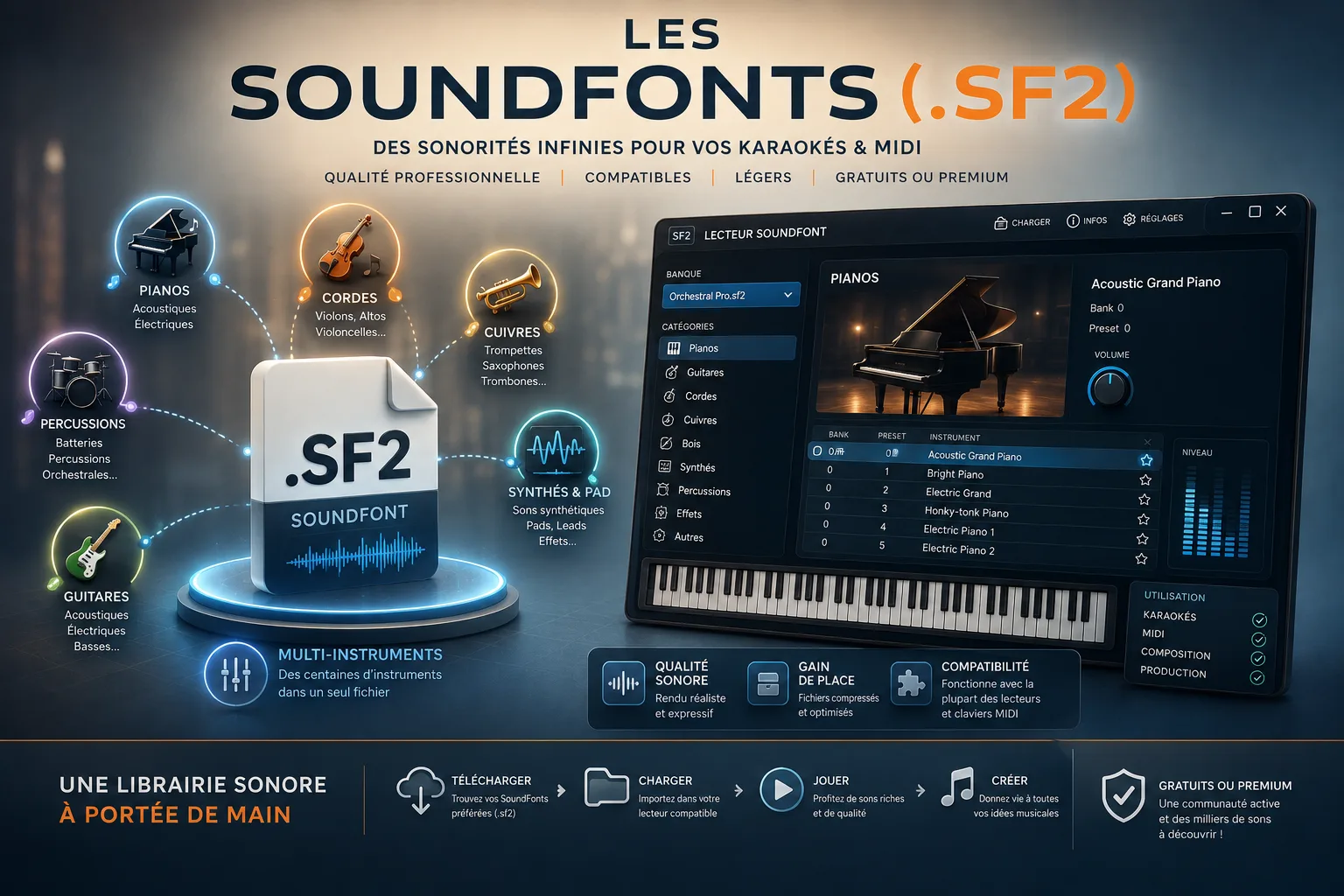
A SoundFont bank supplies a wide range of instruments, almost always as real audio samples: each note is recorded in a studio with a well-placed microphone, and the resulting collection forms a complete instrument that then joins the other 127 in the GM bank (and likewise for the drum/percussion section). Better quality means a bigger bank. This system is functionally a sampler-synthesizer — you can build your own bank from your own recordings and play it live from a keyboard, pads, or any MIDI controller. Single-instrument banks exist too, dedicated to one sound (a violin, or each individual drum) for precise tone-shaping — though for full drum kits, a dedicated tool like EZdrummer is usually the better choice.
On this site, you don't actually need to manage any of this
Everything below is about picking a bank and loading it manually into a player — useful knowledge if you use vanBasco, MIDI Voyager Pro, or any other MIDI software. But if you're listening right here on the site, or using International MIDI Files Player, there's nothing to install: the .sf3 conversion behind that Titanic-quality sound happens automatically, per title, the first time you hit play. No bank to download, no software to configure.
That's specifically why this section still matters, though: outside of this site's own player, nothing gets you good MIDI sound for free without a bank and a way to load it — which is exactly what the rest of this page covers.
SoundFont software worth knowing
A quick note before the list: small one-developer sites tend to disappear over the years (this page has already lost a few over time). What follows leans toward projects with either an active open-source repository or a long track record — a better bet for still being there next time you need them.
On Windows, for everyday playback
CoolSoft VirtualMIDISynth changes how Windows renders MIDI sound system-wide — for playback, karaoke, or games. Easy to install, it manages SoundFont banks for you: pick a good one once, and it stays loaded. See our guide →
Cross-platform & open source
- FluidSynth — the open-source engine that quietly powers a large part of this ecosystem (including this site's own built-in player). Command-line by default, but actively maintained and available for Windows, macOS and Linux — as safe a long-term bet as this space has.
- Polyphone — the reference free, open-source editor for building or tweaking a SoundFont (.sf2/.sf3), also usable simply to preview banks before choosing one. Windows, macOS and Linux.
- Munt Project — a cross-platform software synthesizer emulating the Roland MT-32, for a specific retro sound rather than General MIDI.
Mobile
For karaoke specifically on Android, see our MIDI Voyager Pro guide — it has its own built-in SoundFont support, no separate player needed. On iOS, bs-16i (bismark bs-16i) is the long-standing, still-maintained option for loading a SoundFont as a standalone app or Audio Unit.
General MIDI banks worth having
Titanic is the bank we recommend — balanced, and a good fit across styles. Download it here →
Other well-regarded GM banks not hosted on this site: SGM v2, Arachno (available on the author's own site) and FluidR3 (leans well toward pop).
Where to find more instrument SoundFonts
- musical-artifacts.com — the largest active library today (SoundFonts, SFZ patches and more), organized by license.
- polyphone.io/soundfonts — the selection maintained by the makers of the Polyphone editor, GM banks and single instruments alike.
- awesome-soundfonts (GitHub) — a curated, versioned list of banks and tools, kept up via pull requests rather than a single person's bookmarks — usually a good sign a resource list will still be accurate in a year or two.
A few once-popular sources are worth skipping now: hammersound.net still responds but its download categories are empty, and SF2-files.com's domain is up for sale. It's a pattern worth expecting with single-person sites in this space — another reason we lean on maintained, multi-contributor resources above where we can.